Yes, you can make cables in crochet. They don't look exactly like
knit cables, but you can do as much with them as you can do with knit
ones, and if you don't knit then it's nice to know that you can still
make nice-looking cables.
You're basically using post
dc stitches to make the basic rib for your cable. When you go to twist
them around each other, you'll use post tr stitches to keep your work
flat. It's a bit more involved than making knit cables, but the end
result is the same, you're twisting a number of stitches around each
other, the way you do it will determine what your cable will look like.
All you really have to do is Google 'crochet cables' to find any number of written or video directions on how to do this.
I like the option to be able to put cables on my crochet things too.
Saturday, February 09, 2013


Tuesday, December 04, 2012
Red Heart Super Saver
I've heard (or rather seen) a lot of people posting across the internet about how icky RHSS is. I'll concede that, years ago, it was pretty rough. But, then again, it was also the only affordable yarn for knitters/crocheters who had very little money to spend.
Now, RHSS has softened over the years into something much more workable. And to tell the truth, most people want an item that they can just throw into the washer and dryer without worrying about it losing its shape.
Now, I'm not disrespecting quality yarns at all, I love to use them when I can afford them, as long as they're items for myself so that I know I'll take care of them properly, but for gifts I would use a good quality, soft acrylic.
These days, there are many, many brands of acrylic yarns, but I have no way to get to them except online, so I use mostly what my local W-M offers (sucks, I know, but that's how life is.) When I can afford to get some money into my Paypal I'll shop around for the good stuff, usually on Ebay since they take Paypal and I can usually find something nice at a good price.
Such as the three skeins of sock yarn I purchased a few days ago. I hope this link works.
Brown Sheep Wildfoote
It's in the color Ragtime, which is different colors of purples and plums, some of my favorites.
I can't wait to knit up a pair of socks from this yarn, it's very soft and cushy. But I have other projects that must be finished first, so it will likely be after Christmas.
Now, RHSS has softened over the years into something much more workable. And to tell the truth, most people want an item that they can just throw into the washer and dryer without worrying about it losing its shape.
Now, I'm not disrespecting quality yarns at all, I love to use them when I can afford them, as long as they're items for myself so that I know I'll take care of them properly, but for gifts I would use a good quality, soft acrylic.
These days, there are many, many brands of acrylic yarns, but I have no way to get to them except online, so I use mostly what my local W-M offers (sucks, I know, but that's how life is.) When I can afford to get some money into my Paypal I'll shop around for the good stuff, usually on Ebay since they take Paypal and I can usually find something nice at a good price.
Such as the three skeins of sock yarn I purchased a few days ago. I hope this link works.
Brown Sheep Wildfoote
It's in the color Ragtime, which is different colors of purples and plums, some of my favorites.
I can't wait to knit up a pair of socks from this yarn, it's very soft and cushy. But I have other projects that must be finished first, so it will likely be after Christmas.
Monday, December 03, 2012
Twenty pairs of fingerless mitts
Well, three-fourths of them. I have five more pairs to make before the end of the week. They turned out really nicely and I even found something to store them in to keep them clean, a blanket bag. You know, one of those clear plastic zippered things that some blankets come in when you buy them. It'll hold all twenty pairs nice and neat when I deliver them. I hope everyone who gets a pair will enjoy them.
I truly enjoyed making them, even though it got boring with all those repetitive, sc ribs. I'd have to stop sometimes and switch projects just to keep from getting bored to death. Hey, you sit and crochet nothing but sc rib for days on end and see how bored you get ;)
Still, that's what other projects are for.
I truly enjoyed making them, even though it got boring with all those repetitive, sc ribs. I'd have to stop sometimes and switch projects just to keep from getting bored to death. Hey, you sit and crochet nothing but sc rib for days on end and see how bored you get ;)
Still, that's what other projects are for.
Ruffled scarves
They're all the rage, and rightly so. Soft and squishy and ruffled, you can have one to match every outfit if you like.
The only problem with them is that they're a pain in the backside to knit. You're using a net-like yarn that's about 2-3 inches wide and knitting through the edge of it. You have to stretch it out as you go (or unroll it, stretch it out and re-roll it onto a piece of cardboard). Either way, it's a pain to do that.
The upside is, once you adapt to the netting, things go a bit more smoothly and faster. There are any number of youtube vids about how to do this, along with any number of brands of the netting yarn.
I'm making my first one with Red Heart Boutique Sashay in the Waltz colorway. Take my word for it, it'll look crappy when you first start, but give it a foot or so and it'll start looking really nice. I'm going to give this one to a friend for Christmas, she likes the browns and blues in this particular colorway, so it goes to her.
The only problem with them is that they're a pain in the backside to knit. You're using a net-like yarn that's about 2-3 inches wide and knitting through the edge of it. You have to stretch it out as you go (or unroll it, stretch it out and re-roll it onto a piece of cardboard). Either way, it's a pain to do that.
The upside is, once you adapt to the netting, things go a bit more smoothly and faster. There are any number of youtube vids about how to do this, along with any number of brands of the netting yarn.
I'm making my first one with Red Heart Boutique Sashay in the Waltz colorway. Take my word for it, it'll look crappy when you first start, but give it a foot or so and it'll start looking really nice. I'm going to give this one to a friend for Christmas, she likes the browns and blues in this particular colorway, so it goes to her.
Saturday, December 01, 2012
Crochet hook case
I just received an order of bamboo circular needles and crochet hooks. Knowing me, if I didn't do something, the hooks would end up somewhere that would result in them getting broken, so, I went to Crochet Pattern Central and found a beautiful pattern for a crochet hook case and I made it within a few hours. I used some Caron Simply Soft in a butter yellow color that I have no idea what they call it since I don't have the wrapper for it anymore. You should be able to complete one of these with yarn leftover since this skein was a partial skein and I still had plenty leftover.
Anyway, here's the picture:
 As you can see, the openings are roomy and I doubled up on the smaller sizes. The largest one on the other end is a 10mm, a US P, I think.
I intend to make more of these for my aluminum hooks and figure out how to make a holder for my straight knitting needles and my circulars.
More to come when I get that done.
Anyway, here's the picture:

I intend to make more of these for my aluminum hooks and figure out how to make a holder for my straight knitting needles and my circulars.
More to come when I get that done.
Friday, November 02, 2012
Armwarmers galore
Or it will be, soon. A friend asked me to make 20 pairs of my ribbed fingerless mitts yesterday. She wants to give them to some friends for Christmas.
Good thing these things are so customizable, she likes the length a bit longer, to keep the arm warm as well as the wrist/hand.
Good thing too that it only takes a few hours to make a pair, give or take. I have plenty of time to make them for her.
Good thing these things are so customizable, she likes the length a bit longer, to keep the arm warm as well as the wrist/hand.
Good thing too that it only takes a few hours to make a pair, give or take. I have plenty of time to make them for her.
Sunday, September 09, 2012
Rules and Patterns
I've been crocheting and knitting since I was a little girl and that was a very long time ago (I'm 52 at the time of this posting.). I usually craft in sections (start projects and put them down), so I always have UFOs.
I really hate rules and people who insist one must follow a pattern to the letter. The only rules I follow in knitting are the knit stitch is always done with the yarn in back and the purl stitch is always done with the yarn in front. Other than that, it's whatever I feel like doing.
Take patterns. To me, they're just guides. If I want my finished piece to look exactly like theirs then I'll follow the pattern religiously. Nine times out of ten I won't. I'll use a different yarn or color or incorporate the pattern into something the author likely never envisioned.
It's kind of putting my own signature on things, sort of like freestyle knitting without going crazy. (Though I'd like to try that freestyle one day, I just can't seem to envision anything.)
Anyway, I was reading a blog and the comments and someone had asked the author how they got all the colors in the project they were commenting on to look so nice together and the author said that she tried to keep colors that clash (like red and orange) from touching. That kind of jarred me since I don't think red and orange clash.
So, while I'm knitting up Log Cabin blocks I'm making one just from red and orange to prove my point. I have a nine patch template that I use to test out different looks and made a jigsaw look by making the center block orange, going around three sides of it with red and doing the final block in orange again. So, I have a U-shaped red piece with an orange piece that fits inside the U like a key. I'll post a picture and anyone who stumbles across this can like it or hate it as they will, it's up to the individual on what clashes/doesn't clash and I'm of the opinion that no two colors actually clash, it's all according to the tastes of the individual.
Take orange. It's merely red, watered down with yellow, so why would it clash with red? All colors are mixtures of the three primary colors (red, yellow, blue), plus white and black on occasion. Yes, some colors look better together than others, but no two colors actually clash-in my not so humble opinion.
Picture to come when I finish the block, but here's the template I did:

I call it Jigsaw. I think it looks great.
I really hate rules and people who insist one must follow a pattern to the letter. The only rules I follow in knitting are the knit stitch is always done with the yarn in back and the purl stitch is always done with the yarn in front. Other than that, it's whatever I feel like doing.
Take patterns. To me, they're just guides. If I want my finished piece to look exactly like theirs then I'll follow the pattern religiously. Nine times out of ten I won't. I'll use a different yarn or color or incorporate the pattern into something the author likely never envisioned.
It's kind of putting my own signature on things, sort of like freestyle knitting without going crazy. (Though I'd like to try that freestyle one day, I just can't seem to envision anything.)
Anyway, I was reading a blog and the comments and someone had asked the author how they got all the colors in the project they were commenting on to look so nice together and the author said that she tried to keep colors that clash (like red and orange) from touching. That kind of jarred me since I don't think red and orange clash.
So, while I'm knitting up Log Cabin blocks I'm making one just from red and orange to prove my point. I have a nine patch template that I use to test out different looks and made a jigsaw look by making the center block orange, going around three sides of it with red and doing the final block in orange again. So, I have a U-shaped red piece with an orange piece that fits inside the U like a key. I'll post a picture and anyone who stumbles across this can like it or hate it as they will, it's up to the individual on what clashes/doesn't clash and I'm of the opinion that no two colors actually clash, it's all according to the tastes of the individual.
Take orange. It's merely red, watered down with yellow, so why would it clash with red? All colors are mixtures of the three primary colors (red, yellow, blue), plus white and black on occasion. Yes, some colors look better together than others, but no two colors actually clash-in my not so humble opinion.
Picture to come when I finish the block, but here's the template I did:
I call it Jigsaw. I think it looks great.
Saturday, September 08, 2012
Working on a pattern
It's based on a familiar quilt block pattern called Log Cabin. I'm trying out various configurations and writing them down, along with a few variations on each one. When I'm finished I'll try to add it to my Ravelry account as a free download (never tried that before, so thought I would with this.).
I have three different variations on the pattern, making about a 5-1/2" square (though one could make it larger by adding in a third round of rectangles.). I'm going to keep making small squares until I get enough to make a throw.
And don't you crocheters feel left out, the patterns will transfer easily to crochet and I'll have that written up too.
Don't hold your breath though, I'm notoriously slow. I may have the pattern out faster than I normally work, but the afghan will take awhile.
I have three different variations on the pattern, making about a 5-1/2" square (though one could make it larger by adding in a third round of rectangles.). I'm going to keep making small squares until I get enough to make a throw.
And don't you crocheters feel left out, the patterns will transfer easily to crochet and I'll have that written up too.
Don't hold your breath though, I'm notoriously slow. I may have the pattern out faster than I normally work, but the afghan will take awhile.
Friday, April 13, 2012
Broken links
I've been checking some of my older posts and it seems some links are broken. I'll go through them (my finished projects) and fix them as quickly as I can. Seems ImageShack changed the URLs of my pics and dropped others completely, so if you see a small white square where a picture should be, that's what happened and I likely won't be able to get another up there. For those posts, sorry, but there's nothing I can do.
Doily Baby blanket
I just finished this earlier this morning and thought I'd share it. I used my blackberry so it isn't the clearest of pictures, but you can see it well enough. That's my little grandson Noah showing off the blanket.
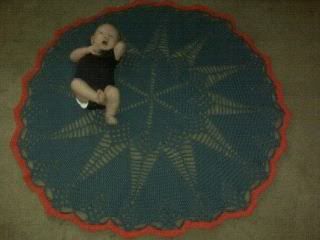
The pattern is called Doily Baby Blanket and I have the pattern in a Red Heart booklet I got from my mom. Now Red Heart has made the blanket a free pattern and it can be found here:
Doily Baby Blanket
So if anyone is interested in making one, you can give it a whirl. I used some old yarn I was given, and the gauge was almost the same as the pattern called for. The final measurement I got was 44-1/2" in diameter instead of 43", so not bad, just a bit bigger.
It will make a nice lapghan, bed decoration or even baby blanket. The pattern is quite simple and only took me a little over two days of straight crocheting. Yes, I have time to sit and crochet almost all day, I babysit the babies while parents work. It could be a nice weekend project when you have nothing else to do and nowhere to go or to be.
Oh, and the two colors are Blue Velvet from Yarns Brunswick (Windrush) and Hot Red from RHSS, which looks like a nice reddish-orange. The Blue Velvet looks like a dark teal.
The pattern is called Doily Baby Blanket and I have the pattern in a Red Heart booklet I got from my mom. Now Red Heart has made the blanket a free pattern and it can be found here:
Doily Baby Blanket
So if anyone is interested in making one, you can give it a whirl. I used some old yarn I was given, and the gauge was almost the same as the pattern called for. The final measurement I got was 44-1/2" in diameter instead of 43", so not bad, just a bit bigger.
It will make a nice lapghan, bed decoration or even baby blanket. The pattern is quite simple and only took me a little over two days of straight crocheting. Yes, I have time to sit and crochet almost all day, I babysit the babies while parents work. It could be a nice weekend project when you have nothing else to do and nowhere to go or to be.
Oh, and the two colors are Blue Velvet from Yarns Brunswick (Windrush) and Hot Red from RHSS, which looks like a nice reddish-orange. The Blue Velvet looks like a dark teal.
Wednesday, February 01, 2012
Hoover Blanket
No, not a bunch of old newspapers to cover up with, but a knitted baby blanket that Herbert Hoover's wife made famous. Personally, I think its name should be differentiated by calling it L. H. Hoover Blanket. Knitty deciphered her pattern and published it:
Hoover Blanket
I'm making one in RHSS Aran Fleck and a Sage green for the contrast panel. I'm making version 3. It isn't really hard to do if you don't mind carrying two colors along and you can do 1x1 ribbing. The end result will be a blanket with a wide border and a double knitted stockinette stitch center panel which will be reversible. I cast on 130 instead of 110 so that I would have an even hundred stitches for the center panels.
Personally, I don't see how she could knit 190 stitches using straight needles without constantly dropping stitches, unless straight needles in her era were longer than the straight needles we have now, because they likely didn't have circular needles back then.
Well, after some digging, I found that circular needles were around at that time, since they were invented post-WWI, so it is possible that Lou Henry Hoover had some for her baby blankets.
Pretty cool, huh?
Hoover Blanket
I'm making one in RHSS Aran Fleck and a Sage green for the contrast panel. I'm making version 3. It isn't really hard to do if you don't mind carrying two colors along and you can do 1x1 ribbing. The end result will be a blanket with a wide border and a double knitted stockinette stitch center panel which will be reversible. I cast on 130 instead of 110 so that I would have an even hundred stitches for the center panels.
Personally, I don't see how she could knit 190 stitches using straight needles without constantly dropping stitches, unless straight needles in her era were longer than the straight needles we have now, because they likely didn't have circular needles back then.
Well, after some digging, I found that circular needles were around at that time, since they were invented post-WWI, so it is possible that Lou Henry Hoover had some for her baby blankets.
Pretty cool, huh?
Monday, December 26, 2011
You're knitting wrong,
Well, I haven't had anyone actually tell me that before, but I've read about it. Some beginner knitter will hear it from some knitting snob who knits differently.
There are actually three styles of knitting, with untold variations between:
Continental: The continental knitter holds the yarn in the left hand, much like a crocheter would and picks up the stitches with the working needle. I can knit this way since I'm a crocheter, but I find it slows me down.
English: The English knitter holds the yarn in the right hand, sometimes sort of wrapping it around the fingers as a crocheter does. They 'throw' the yarn over the working needle to make the stitch.
Combined: The Combined knitter can either be Continental or English. It's the way they make their stitches that distinguishes them. Instead of making the purl stitch by wrapping the yarn over the top of the needle, they wrap it from the bottom. This will twist the stitch, putting the front leg of the stitch (when the work is turned to work back the other way) in the back. To keep the stitch from twisting when it is then worked, the working needle would have to be inserted in the back of the stitch. They say this prevents 'rowing out', making your stockinette stitch and ribbing look smoother.
So what am I? I use the English method of 'throwing' the yarn, but I don't wrap it around my fingers for tension. I simply hold it in my hand, along with the working needle. When I throw the yarn I let the needle go (bracing it with my left hand as I do so), wrap the yarn, grab the needle and complete the stitch. I don't notice any discernible loss of speed doing this (but I've been knitting this way for over 40 years too). If any knitting snob were to come up to me (if I were knitting in public, which I do on occasion) and tell me I was doing it wrong, I would have to then ask them:
"Does this look like (whatever stitch I'm knitting)?" "It does? Then what am I doing wrong?"
I mean, really, just because I don't hold my needles and yarn like you do doesn't mean I'm doing it wrong, it just means I'm doing it differently from you. Get. Over. It.
There are actually three styles of knitting, with untold variations between:
Continental: The continental knitter holds the yarn in the left hand, much like a crocheter would and picks up the stitches with the working needle. I can knit this way since I'm a crocheter, but I find it slows me down.
English: The English knitter holds the yarn in the right hand, sometimes sort of wrapping it around the fingers as a crocheter does. They 'throw' the yarn over the working needle to make the stitch.
Combined: The Combined knitter can either be Continental or English. It's the way they make their stitches that distinguishes them. Instead of making the purl stitch by wrapping the yarn over the top of the needle, they wrap it from the bottom. This will twist the stitch, putting the front leg of the stitch (when the work is turned to work back the other way) in the back. To keep the stitch from twisting when it is then worked, the working needle would have to be inserted in the back of the stitch. They say this prevents 'rowing out', making your stockinette stitch and ribbing look smoother.
So what am I? I use the English method of 'throwing' the yarn, but I don't wrap it around my fingers for tension. I simply hold it in my hand, along with the working needle. When I throw the yarn I let the needle go (bracing it with my left hand as I do so), wrap the yarn, grab the needle and complete the stitch. I don't notice any discernible loss of speed doing this (but I've been knitting this way for over 40 years too). If any knitting snob were to come up to me (if I were knitting in public, which I do on occasion) and tell me I was doing it wrong, I would have to then ask them:
"Does this look like (whatever stitch I'm knitting)?" "It does? Then what am I doing wrong?"
I mean, really, just because I don't hold my needles and yarn like you do doesn't mean I'm doing it wrong, it just means I'm doing it differently from you. Get. Over. It.
Sunday, December 25, 2011
Almost there
I've almost perfected the pattern for the fingerless gloves knitted flat. It took several tries to get the stitch count right, but I think I'm almost there. I'll know when I sew the latest glove together.
Mind you, it sort of resembles a misshapen turkey when you're through knitting it, but once you get it sewn together it looks very nice.
Mind you, it sort of resembles a misshapen turkey when you're through knitting it, but once you get it sewn together it looks very nice.
Wednesday, December 21, 2011
Ribbing
Specifically, knitted ribbing.
I don't know why about 99% of the patterns I run across that call for ribbing (socks and hats mostly since I don't do large wearables) call for 2x2 ribbing. To me, 1x1 ribbing looks so much nicer and has more stretch to it.
Therefore, when I run across a pattern I like and it calls for 2x2 ribbing I will change that to 1x1 ribbing.
The fingerless gloves and matching hat I just finished look really nice with it. My grandchildren insisted on modeling them even though they're made for their father. The patterns will be up on my pattern blog later on after I proofread it for mistakes.


I don't know why about 99% of the patterns I run across that call for ribbing (socks and hats mostly since I don't do large wearables) call for 2x2 ribbing. To me, 1x1 ribbing looks so much nicer and has more stretch to it.
Therefore, when I run across a pattern I like and it calls for 2x2 ribbing I will change that to 1x1 ribbing.
The fingerless gloves and matching hat I just finished look really nice with it. My grandchildren insisted on modeling them even though they're made for their father. The patterns will be up on my pattern blog later on after I proofread it for mistakes.


Monday, December 19, 2011
Finished one fingerless glove
Well, I think I have the pattern for the two-needle glove nearly tweaked. The prototype looked wonky, even when sewn together and I figured out the problem there. I needed to decrease the number of cast-on stitches from 44 to 42. Then I needed to decrease the number of cast-on stitches for between the fingers from 2 to one. I also had to tweak how I did the thumb.
All in all, the glove still looks a bit wonky (especially with all the long ends hanging off it), until you get it sewn together, then it looks quite nice. And if you seam it carefully, the seams barely show.
Yes, there are about 18 long ends to weave in, but remember, there are 4 fingers and a thumb on each glove and you have to make half of each in the right spot for it to come out right. You would have about half that number of ends if you knitted in the round, and you would only have to hide them and not use them to sew any seams.
This pattern is not for those who like to knit in the round (unless they just want to try it to say they did it), it's for those who are intimidated by knitting in the round, but can knit up a storm on straight needles. You could use a circular needle to knit these, just knit back and forth as if you were using straight needles. It is also not for beginner knitters. I put the difficulty rating at intermediate/hard. I'm not saying a beginner *couldn't* do them, just that they may find it difficult at first.
As I said before, it will look a little wonky when you're finished, but it will look like a fingerless glove when you sew it together. I recommended that you leave long ends when binding off so that they may be used to sew the finger seams and side seams. The loose end from the cast-on can be used to sew up the long side seam of the glove and then hidden. If it isn't long enough, then sew as far as you can and work the end into the glove, then use the end from the pinky to sew down the other part of the side seam.
You could also make a pair of full gloves with this pattern, just leave your ends a lot longer to give yourself plenty of sewing yarn.
All in all, the glove still looks a bit wonky (especially with all the long ends hanging off it), until you get it sewn together, then it looks quite nice. And if you seam it carefully, the seams barely show.
Yes, there are about 18 long ends to weave in, but remember, there are 4 fingers and a thumb on each glove and you have to make half of each in the right spot for it to come out right. You would have about half that number of ends if you knitted in the round, and you would only have to hide them and not use them to sew any seams.
This pattern is not for those who like to knit in the round (unless they just want to try it to say they did it), it's for those who are intimidated by knitting in the round, but can knit up a storm on straight needles. You could use a circular needle to knit these, just knit back and forth as if you were using straight needles. It is also not for beginner knitters. I put the difficulty rating at intermediate/hard. I'm not saying a beginner *couldn't* do them, just that they may find it difficult at first.
As I said before, it will look a little wonky when you're finished, but it will look like a fingerless glove when you sew it together. I recommended that you leave long ends when binding off so that they may be used to sew the finger seams and side seams. The loose end from the cast-on can be used to sew up the long side seam of the glove and then hidden. If it isn't long enough, then sew as far as you can and work the end into the glove, then use the end from the pinky to sew down the other part of the side seam.
You could also make a pair of full gloves with this pattern, just leave your ends a lot longer to give yourself plenty of sewing yarn.
Thursday, December 15, 2011
Knitted gloves on two needles
You know, there are countless patterns out there for knitted gloves-both for sale and for free. Most of those patterns call for either one long circular needle for magic loop, two circular needles (used a lot like dpns, but better) or double pointed needles (dpns).
But what about those of us who don't like/are intimidated by knitting in the round, especially socks or gloves? I've seen sock patters for two needles, but very few glove patterns for two needles (though I admit I haven't done a thorough search. But I have a feeling that there aren't very many anyway, either for free or for sale.)
Therefore, I am attempting to knit a pair of fingerless gloves with partial fingers in them for my SiL, whose steering wheel is very cold when the weather is cold, but he likes having the ends of his fingers free. I suspect what I come up with could also be used to make full gloves as well (just keep knitting the fingers till they're long enough.)
My premise is that I can knit the glove in one piece with only one side seam and then the finger seams. We'll see what I come up with. When it goes up, naturally it will be free for personal use/gift-giving. Just credit me for the design if anyone asks where you got the pattern, as a courtesy to my hard work.
Oh, and I do like knitting in the round, but this is for those of you who are intimidated by it or who can do it but just don't like it.
But what about those of us who don't like/are intimidated by knitting in the round, especially socks or gloves? I've seen sock patters for two needles, but very few glove patterns for two needles (though I admit I haven't done a thorough search. But I have a feeling that there aren't very many anyway, either for free or for sale.)
Therefore, I am attempting to knit a pair of fingerless gloves with partial fingers in them for my SiL, whose steering wheel is very cold when the weather is cold, but he likes having the ends of his fingers free. I suspect what I come up with could also be used to make full gloves as well (just keep knitting the fingers till they're long enough.)
My premise is that I can knit the glove in one piece with only one side seam and then the finger seams. We'll see what I come up with. When it goes up, naturally it will be free for personal use/gift-giving. Just credit me for the design if anyone asks where you got the pattern, as a courtesy to my hard work.
Oh, and I do like knitting in the round, but this is for those of you who are intimidated by it or who can do it but just don't like it.
Thursday, December 08, 2011
Four fingers and half a thumb
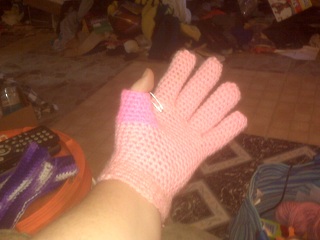
Thumb gussets are a must for a proper fit.
I like having the body of the glove come about an inch below the bottom of the hand.
You will frog, several times, before you get the look and fit that you want.
As I said, thumb gussets are a must, but you can still make ambidextrous gloves and use them, simply put your thumb gusset on one side of the glove and start your little finger on the other side, this way you won't have to worry about which glove goes on which hand, because it don't matter.
Why is the thumb being done in a darker pink? Two reasons. I'm about to run out of the light pink and I wanted you to see what the thumb looked like while it was being constructed. I'll be using the same darker pink in the wrist ribbing as well so that it will balance out. Why am I still working on the glove if I don't have any more of the light pink? It's a practice glove, it wasn't meant to have a mate. And no, I will not be wearing it a la Michael Jackson. It will simply sit as testament that yes, I can crochet a decent-looking glove, with fingers.
Glove in Progress

As you can see from the bad picture (I used my phone and that's my hand so it shows the flash pretty bad), I've gotten two fingers completed. I've started on the middle finger and then I'll just have the index finger and thumb left to do on the main glove. I'm pretty sure there's a pattern out there similar to this one, but, as I said, I couldn't find one using yarn/hooks I already had.
You'll notice there's no ribbing on the wrist. That's because I haven't done any yet. The glove itself comes about an inch below the hand, which, while a bit unplanned, is something I find I like. All those other gloves which have the ribbing come directly to the bottom of the hand before shaping glove I find are a bit uncomfortable anyway.
I plan to use a technique that I found on the web a few years back, which is actually similar to a method I'd developed myself, to attach the ribbing. Essentially, it will be crocheted onto the bottom of the glove and then the two ends crocheted together. I'll be using a hook two sizes smaller than the one I did the glove with to do this with so that the ribbing will be snug.
I will attempt to write out how I did this, but it will still either entail lots of trying on or really good measuring of the hand that the glove will be going on to make this glove.
Wednesday, December 07, 2011
More about my trial (and error) with making my own gloves
I tried one thing and it looked, well, horrible. Kind of like a mutated, five-fingered spider.
So I started all over again from scratch and I think I've found a good formula, but it will still take lots of trial (and error) to get right. It will also require lots of trying on to get the fingers right. So making gifts, unless one is exceptionally skilled, or has hands like the giftee, this won't be the pattern for them.
However, I usually make my patterns for my own use anyway and put it up for others to try if they like.
So I started all over again from scratch and I think I've found a good formula, but it will still take lots of trial (and error) to get right. It will also require lots of trying on to get the fingers right. So making gifts, unless one is exceptionally skilled, or has hands like the giftee, this won't be the pattern for them.
However, I usually make my patterns for my own use anyway and put it up for others to try if they like.
Gloves
I love crocheting fingerless mitts, as you can see from some of my previous posts. They allow me to keep my hands warm while leaving my fingers free to type, knit or crochet.
However, my husband does not like them. He told me he wants gloves, with fingers in them. I've scoured Crochetpatterncentral and Knittingpatterncentral and while I've saved some patterns to try out later, I wanted to do him some gloves *now*, not have to go to the store and buy yarn and needles (likely I'd have to order the needles anyway).
So I've picked some yellow Simply Soft from my stash and crochet hooks and I am working on something. I'm writing it down as I go and will put it up on my pattern blog as soon as I'm finished. A word of warning-they will not be easy for a beginner, most likely you'll have to be an intermediate crocheter or better to make them.
However, my husband does not like them. He told me he wants gloves, with fingers in them. I've scoured Crochetpatterncentral and Knittingpatterncentral and while I've saved some patterns to try out later, I wanted to do him some gloves *now*, not have to go to the store and buy yarn and needles (likely I'd have to order the needles anyway).
So I've picked some yellow Simply Soft from my stash and crochet hooks and I am working on something. I'm writing it down as I go and will put it up on my pattern blog as soon as I'm finished. A word of warning-they will not be easy for a beginner, most likely you'll have to be an intermediate crocheter or better to make them.
Subscribe to:
Comments (Atom)